Commercial Slush Machine Breakdowns: 5 Common Causes
Last Updated: November 2, 2026
Quick Summary
Most slush machine breakdowns trace back to five common causes: a dirty condenser coil, low refrigerant, a failed auger or gear motor, worn seals and gaskets that leak, and an incorrect sugar ratio. Nearly all of these faults show warning signs first, so regular cleaning, seal checks and correct mix ratios prevent most failures.
- A commercial slush machine not freezing usually traces to a dirty condenser coil, low refrigerant, a failed auger or gear motor, or a mix too thick to freeze.
- A leaking machine usually leaks from the bowl gasket, tap O-ring, drive shaft seal or a cracked bowl.
- Clean the condenser coil and check airflow weekly, and move to twice weekly in summer if the machine runs continuously.
- Hard water leaves scale on the evaporator, forcing the compressor to run longer and hotter, so descale monthly in hard-water areas.
- If a fault involves gas, wiring or the compressor, stop and call a professional.
Table of Contents
- Why Commercial Slush Machine Breakdowns Usually Start Small
- Commercial Slush Machine Not Freezing: The Faults Behind It
- Slush Machine Leaking: Where the Liquid Actually Comes From
- Slush Machine Cleaning and Maintenance: The Schedule That Prevents Breakdowns
- Slush Machine Sugar Ratio: Getting the Mix Right
- Book a Service or Match a Machine to Your Site
- Frequently Asked Questions
Why Commercial Slush Machine Breakdowns Usually Start Small
Most commercial slush machine breakdowns begin with something a busy operator never notices: a worn seal, a dirty condenser coil, a mix slightly too thick.
A slush machine breakdown is any fault that stops the machine freezing, dispensing or holding product safely.
The good news? Almost every one of these faults gives warning signs first.
Commercial Slush Machine Not Freezing: The Faults Behind It
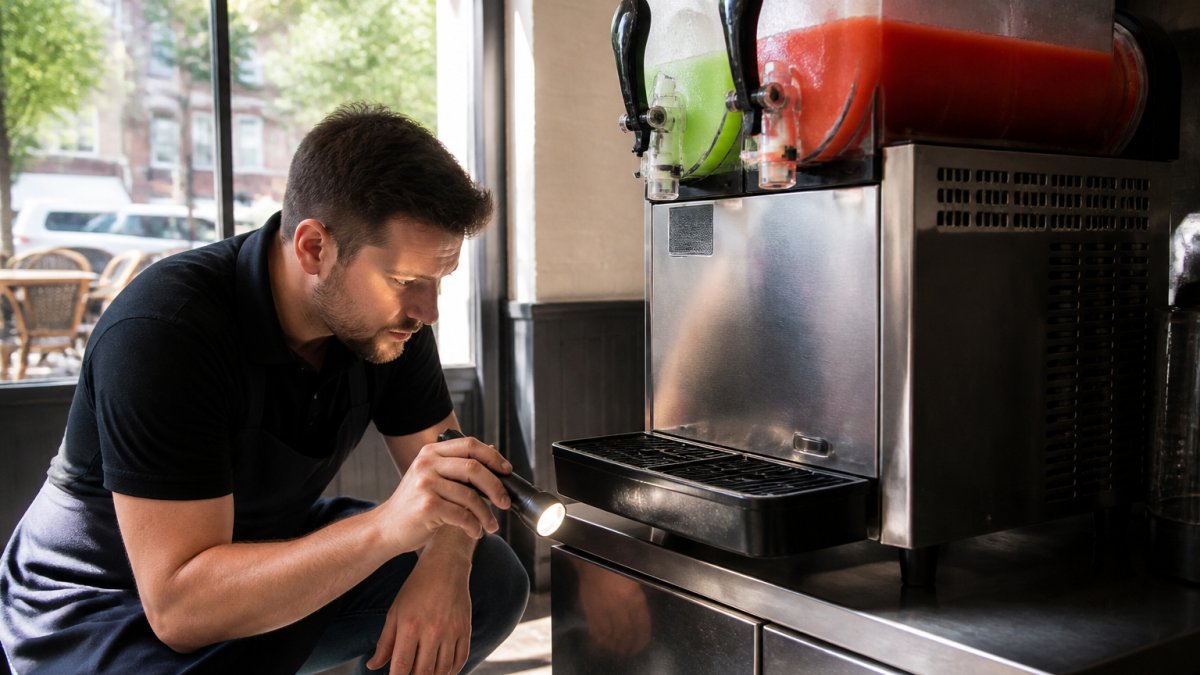
A commercial slush machine not freezing almost always traces back to one of four things: a dirty condenser coil, low refrigerant, a failed auger or gear motor, or a mix that is too sugary or too thick to freeze properly. The machine is usually protecting itself, not broken.
Work through the likely causes in this order:
- Airflow and condenser coil. A coil clogged with dust, or a machine tight against a wall, traps heat and slows or stops the freezing cycle.
- Thermal overload. A hot compressor trips its cutout, shutting down and restarting later, which looks like an intermittent fault.
- Refrigerant leak. Poor freezing on one bowl but not the other often points to a low charge or blocked capillary tube. This needs an engineer, not a top-up kit.
- Auger and gear motor. If the auger stops turning, the mix freezes solid around the evaporator. Listen for a straining motor or clicking relay.
- Dilution ratio. Mix too thick or too sugary raises viscosity and overloads the drive system.
Start with the free checks: airflow, coil cleanliness and mix consistency. Those three account for a large share of “not freezing” callouts.
Slush Machine Leaking: Where the Liquid Actually Comes From
A leaking slush machine usually leaks from one of four places: the bowl gasket, the dispensing tap O-ring, the drive shaft seal, or a cracked bowl. Finding the source takes five minutes and saves a callout fee.
Here is how to trace it:
- Drip from the tap spout: worn tap O-ring or a tap not seated correctly after cleaning.
- Liquid running down the outside of the bowl: a perished bowl gasket, often caused by harsh cleaning chemicals.
- Pooling under the machine at the back: drive shaft seal failure, which lets mix escape toward the motor.
Watch out: a slow leak at the rear seal can reach the electrical components and cause a short. If you see liquid near the wiring, switch off at the isolator and stop using the machine.
Replace gaskets and O-rings at the first sign of hardening or flattening, cheap parts that protect expensive ones.
Slush Machine Cleaning and Maintenance: The Schedule That Prevents Breakdowns
Preventative maintenance is one of the most effective ways to avoid slush machine breakdowns. A fixed cleaning and service schedule keeps the condenser clear, the seals soft and the auger free, removing most of the causes above.
| Task | Frequency | Why It Matters |
|---|---|---|
| Flush and sanitise bowls and taps | Daily | Stops sugar residue and bacteria build-up |
| Remove and clean tap assemblies | Daily | Prevents O-ring wear and sticking |
| Clean condenser coil and check airflow | Weekly | Keeps the compressor cool |
| Inspect gaskets and O-rings | Weekly | Catches leaks before they reach electrics |
| Lubricate seals with food grade grease | Weekly | Keeps seals supple and sealing |
| Descale and deep clean | Monthly | Removes scale buildup from hard water |
| Engineer service and refrigerant check | Per service interval | Catches refrigerant and motor faults early |
Two things most guides miss. First, water quality matters: hard water leaves scale on the evaporator, which insulates it and forces the compressor to work harder. Second, never use abrasive or chlorine-heavy cleaners on seals; they harden rubber and cause the leaks you are trying to prevent.
Seasonal maintenance checklist
A proactive seasonal schedule can be more useful because slush machines work hardest in warm weather and then sit idle for months.
Before peak season (late spring):
- Descale the evaporator and bowls thoroughly, then flush with clean water.
- Replace every gasket, O-ring and tap seal that has hardened or flattened over winter.
- Clean the condenser coil and confirm at least 100 mm of clear space around vents; check the machine is not boxed in by stock or shelving.
During peak season (summer):
- Move condenser cleaning from weekly to twice weekly if the machine runs continuously in a warm room.
- Check tap assemblies more often because sugar residue stiffens faster in heavy use.
- Keep a log of freeze times; a gradual lengthening is an early sign of scale or refrigerant loss.
After peak season (autumn):
- Drain, flush and sanitise all bowls, taps and lines before storage.
- Remove and store seals separately if the manufacturer allows, or lubricate them before a long idle period.
- Clean the condenser and cover the machine to keep dust out of the coil.
Winter idle checks:
- Inspect seals monthly for cracking or flattening.
- Run the machine briefly every few weeks to circulate lubricant and confirm the auger turns freely.
- Check for condensation or damp around electrical components in unheated storage.
Ventilation and airflow
A slush machine rejects heat through its condenser, so airflow is not optional. A machine pushed tight against a wall or surrounded by boxes runs hotter, freezes more slowly and trips its thermal overload more often. Keep vents clear, avoid siting the unit next to ovens or fryers, and check room extraction is adequate if several chilled appliances share the space.
Water quality and scale
Hard water is a silent killer. Scale builds on the evaporator surface, insulates it from the mix and forces the compressor to run longer and hotter. Descale monthly in hard-water areas, or fit a water softener or filtration if the machine is fed from the mains.
If you want the fuller picture on why planned care beats waiting for a fault, read our guide on why preventative maintenance is better than reactive maintenance. For a wider rundown of the faults we see most, see common issues with slush machines and how to avoid them.
Slush Machine Sugar Ratio: Getting the Mix Right
The correct slush machine sugar ratio is the one your syrup or mix supplier specifies, measured precisely and kept consistent. Too much sugar lowers the freezing point and the product stays wet.
Sugar content drives two things: how readily the mix freezes and how thick it becomes. Both affect the freezing cycle and the load on the drive system. A mix too thick is a common cause of auger strain and thermal overload.
A few rules we would give any operator:
- Measure with a jug or scale, never by eye.
- Keep the same ratio every batch so the machine runs predictably.
- Do not top up a low bowl with neat syrup to “catch up”.
Getting the ratio right is free, and it removes one of the most common reasons commercial slush machines break down.
Book a Service or Match a Machine to Your Site
Deciding between DIY and professional repair comes down to the fault, the age of the machine and what downtime costs you. Cleaning, gasket swaps and ratio checks are safe to do yourself. Refrigerant work, compressor faults, motor replacement and electrical issues need a qualified engineer.
A simple diagnostic order
Before you call anyone, work through the fault in this order. It is the same sequence an engineer will follow, and it tells you whether the problem is within your competence.
- Is the machine receiving power and is the isolator on? Check the plug, breaker and any residual current device. A tripped supply looks like a dead machine.
- Is the condenser clear and is there airflow? A clogged coil or a machine boxed in by stock causes slow freezing and thermal overload.
- Is the mix correct? Check the dilution ratio against the supplier’s stated figure. Too thick a mix strains the auger and gear motor.
- Is the fault in one bowl or both? One bowl points to a tap, seal or local freezing issue; both bowls point to refrigerant, compressor or supply.
- Are there fault codes or unusual noises? Note them down; they shorten the engineer’s diagnosis and the callout.
- Is there liquid near wiring? If so, switch off at the isolator and stop using the machine.
DIY versus professional repair: the trade-off
A cost-benefit view helps you decide whether a repair is worth doing at all.
- DIY is sensible for: cleaning, descaling, gasket and O-ring replacement, tap assembly swaps, ratio correction and airflow checks, low-risk tasks that remove a large share of common faults.
- Professional repair is necessary for: refrigerant leaks and recharging, compressor replacement, auger motor and gearbox work, control board faults and any electrical diagnosis. These require refrigerant handling competence and test equipment, and attempting them can void warranties and create safety risks.
- Replace rather than repair when: the repair cost approaches a significant share of a new unit’s price, the machine is old and parts are hard to source, or repeated faults are costing you trading days. A machine that fails in peak season has a downtime cost that often exceeds the repair bill.
Operators who keep a simple fault log, date, symptom, action taken, make better repair-or-replace decisions because they can see whether faults are increasing.
Our rule of thumb: if the fault involves gas, wiring or the compressor, stop and call a professional. If you are weighing up the two paths, our guide on DIY versus professional servicing sets out the trade-offs clearly.
If a machine is beyond economic repair, or you are adding a second unit for peak demand, you can browse commercial slush machines for sale to match capacity to your site.
Frequently Asked Questions
Why is my commercial slush machine not freezing?
The usual culprits are a mix that is too weak in sugar, a blocked or iced-up condenser coil, or a machine running in a space with poor airflow. Check the sugar ratio first, then confirm the condenser is clear and the vents are not pushed against a wall. If the bowl stays liquid but the auger still turns, the freezing cycle is running but the refrigerant circuit or thermostat may be at fault, which needs an engineer.
How often should a commercial slush machine be cleaned and serviced?
Clean the bowls, augers and dispensing taps daily at close, and run a full strip-down with food-grade sanitiser at least weekly. A professional service, covering the condenser coil, seals, gaskets and electrical components, should happen every three to six months depending on how hard the machine works. Venues running peak summer demand should lean towards the shorter interval.
What sugar ratio keeps a slush machine working properly?
Sugar controls the viscosity and freezing point of the mix. Too little sugar and the product sets rock hard, loading the auger and gear motor; too much and it stays syrupy and never reaches a slush. Follow the syrup manufacturer’s dilution ratio exactly and measure with a jug rather than eyeballing it. Water quality matters too, as hard water encourages scale buildup in the bowl and lines.
When should I call an engineer rather than fix it myself?
Call an engineer for anything involving refrigerant, the compressor, thermal overload trips, fault codes you cannot clear, or a persistent leak from the rear of the machine. Seals, gaskets, o-rings, cleaning and dilution are reasonable to handle in-house. A leaking refrigerant circuit is not a DIY job and handling it without the right training is both ineffective and unsafe.
Commercial slush machine breakdowns are rarely sudden, and almost always preventable. If you are tired of unreliable kit and slow repairs, Longo & Co supplies durable, energy-efficient slush and soft serve machines, backed by a 12-month limited warranty, flexible rental options and dedicated technical support. Get started with Longo & Co and keep your slush flowing through every peak.