Which Soft Serve Machine Size Is Right for Your Business?
Last Updated: November 5, 2026Quick Summary
The right soft serve machine size depends on your busiest hour, not your daily average. Count peak-hour transactions, multiply by the share that will buy soft serve and your portion size, then add a 20-30% buffer to get the litres per hour you need. Size for the 15-minute burst within that hour, not the hourly average.
- Pull your busiest trading hour from at least four typical weeks, not a single quiet week.
- Add a 20-30% buffer to cover waste, overfill and variation in serving size.
- A queue can land in a 15-minute window, so size for that burst as well as the hour.
- Add a 20-40% growth margin on the burst figure and record the assumption.
- Compare sustained output and recovery time with suppliers, not just headline output.
Table of Contents
- Why Machine Size Matters More Than Price
- Estimating Your Peak-Hour Demand
- Soft Serve Machine Output Per Hour: Reading the Specifications
- Hopper Capacity and Cylinder Size Explained
- Countertop vs Floor-Standing Soft Serve Machines
- Soft Serve Machine Dimensions and Space Requirements
- Electrical, Ventilation and Site-Readiness Checks
- Total Cost of Ownership by Machine Size
- Booking Your Sizing Consultation with Longo & Co
- Frequently Asked Questions
Why Machine Size Matters More Than Price
Choosing the right soft serve machine size is the decision that most affects whether your investment pays back. For a broader framing of sizing by business type, read this companion guide on machine sizing. A machine that is too small turns away customers at the busiest times, while one that is too large sits idle and ties up capital, floor space and power. Café owners, parlour operators and caterers often make the same mistake: they compare purchase prices first and sizing second, when the reverse order protects their margins. The question is not how much a machine costs but how much product it must produce during your peak hour. Start there, and the price comparison becomes far more useful. Working through the sizing method in this guide before requesting any quotation can give you a defensible number to bring to the conversation.Estimating Your Peak-Hour Demand
Machine size is driven by your busiest hour, not your daily average. The practical way to size is to translate a customer count into a required output figure in litres or portions per hour, then compare that figure with the machine’s sustained output. Work through the following method in order. It takes about an hour with your till data and a calculator. Step 1: Identify the true peak hour. Pull your busiest trading hour from at least four typical weeks, not a single quiet week. If you are pre-opening, use comparable local businesses or your own event bookings. Record the number of transactions in that hour, not the number of items. Step 2: Estimate the soft serve attachment rate. This is the share of those transactions that will include a soft serve portion. If you have no trading history, a common pattern is to assume a conservative attachment rate and test it after opening. Step 3: Convert portions to output. Multiply peak transactions by the attachment rate to get portions per peak hour. Then multiply by your planned average portion size in millilitres. For example, 120 transactions × 0.35 attachment = 42 portions; at 125 ml per portion that is 5.25 litres per peak hour. Step 4: Model the burst, not just the hour. A queue does not arrive evenly across 60 minutes. In many cafés and parlours, half the peak-hour volume lands in a 15-minute window. If 21 of those 42 portions are ordered in 15 minutes, the machine must deliver about 84 portions per hour during that burst, even though the hourly average is lower. Step 5: Add a growth and seasonality margin. A machine bought for today’s peak will be undersized within two summers if trade grows. Add a margin you can justify, commonly 20-40% on top of the burst figure, and record the assumption so you can revisit it. Seasonal peaks (weekends, school holidays, events) should be modelled separately if they are materially higher than your weekday peak. Step 6: Sanity-check against till data after opening. Revisit the estimate after two or three months. Compare actual peak-hour portions with your model. If actual demand is consistently above 80% of the machine’s sustained output, you are close to the limit and should plan for a second unit or a larger model before the next peak season. A simple sizing worksheet is worth keeping: peak transactions, attachment rate, portion size, burst factor, growth margin, and required litres per hour. Bring that sheet to any supplier conversation and you will be comparing machines on a like-for-like basis rather than on headline claims. The six steps below set out the sizing method in order, from peak-hour transactions to a sanity check after opening.| Step | What to do | Time or frequency |
|---|---|---|
| Identify the true peak hour | Pull busiest hour from at least four typical weeks | Before requesting quotes |
| Estimate attachment rate | Share of transactions that include soft serve | Test after opening |
| Convert portions to output | Peak transactions × attachment × portion size, plus 20-30% buffer | One-time calculation |
| Model the burst | Size for the 15-minute window holding about half the peak volume | Per peak hour |
| Add growth margin | Add 20-40% on the burst figure and record the assumption | Revisit yearly |
| Sanity-check after opening | Compare actual peak portions with the model | Every 2-3 months |
Soft Serve Machine Output Per Hour: Reading the Specifications
Manufacturers quote output per hour, but the figure needs careful reading before you use it. Output tells you how much product a machine can produce under specified conditions, which is not the same as how much you can dispense during a rush. The gap between the two is where most sizing mistakes happen. Check the following on any specification sheet:- The stated output per hour and the conditions under which it was measured
- The serving or portion size assumed in any “servings per hour” claim
- Whether the figure refers to a single flavour or to twin-flavour operation
- The recovery time between batches once product has been drawn
- The mix feed system (gravity or pump) and whether output assumes a full hopper
Advertised output versus sustained output
Advertised output is usually the best case, achieved in a short burst. Sustained output is what the machine can keep delivering across a full hour of continuous serving. For sizing, sustained output is the figure that matters, because a queue built up at 2pm does not clear itself. Ask any supplier to confirm the sustained figure and the conditions behind it, and to explain how the number was reached rather than simply quoting a headline.Hopper capacity versus cylinder capacity
A frequent confusion is between storage and production. The hopper holds liquid mix; the freezing cylinder holds product that is already frozen and ready to dispense. A large hopper with a small cylinder can hold plenty of mix but struggle to deliver it quickly during a rush. A large cylinder with a small hopper can dispense fast but run dry during sustained service. Check both figures, and check the refill routine: some machines allow top-up during service, others require the machine to be stopped.Recovery time and the burst problem
Recovery time is the period the machine needs to refreeze product after a run of portions. It is the specification most often omitted from sales literature and the one that most affects queue behaviour. A machine with a short recovery time can serve a burst and return to full readiness quickly; a long recovery time leaves customers waiting even when the hourly output figure looks adequate. Ask for the recovery time in minutes and the number of portions drawn before recovery begins.A specification checklist for supplier conversations
When comparing two machines, put the same questions to both suppliers:- What is the sustained output per hour, and at what portion size?
- What is the recovery time, and after how many portions does it start?
- What are the hopper and cylinder capacities in litres?
- Is the output figure for one flavour or two, and does running two flavours reduce output?
- What electrical supply does the machine require, and does it need a dedicated circuit?
- What clearance is needed for airflow and servicing?
Hopper Capacity and Cylinder Size Explained
The hopper holds the liquid mix before it enters the freezing cylinder. Cylinder size governs how much product is frozen and ready to dispense at any moment. Together they determine how the machine behaves under sudden demand. A large cylinder with a small hopper will run out of mix during sustained service. A large hopper with a small cylinder may hold plenty of mix but struggle to deliver it quickly enough. Check both figures before deciding. Pay particular attention to recovery time: the period the machine needs to refreeze product after a run of portions. A short recovery time suits a busy counter, while a long one leaves customers waiting.Countertop vs Floor-Standing Soft Serve Machines
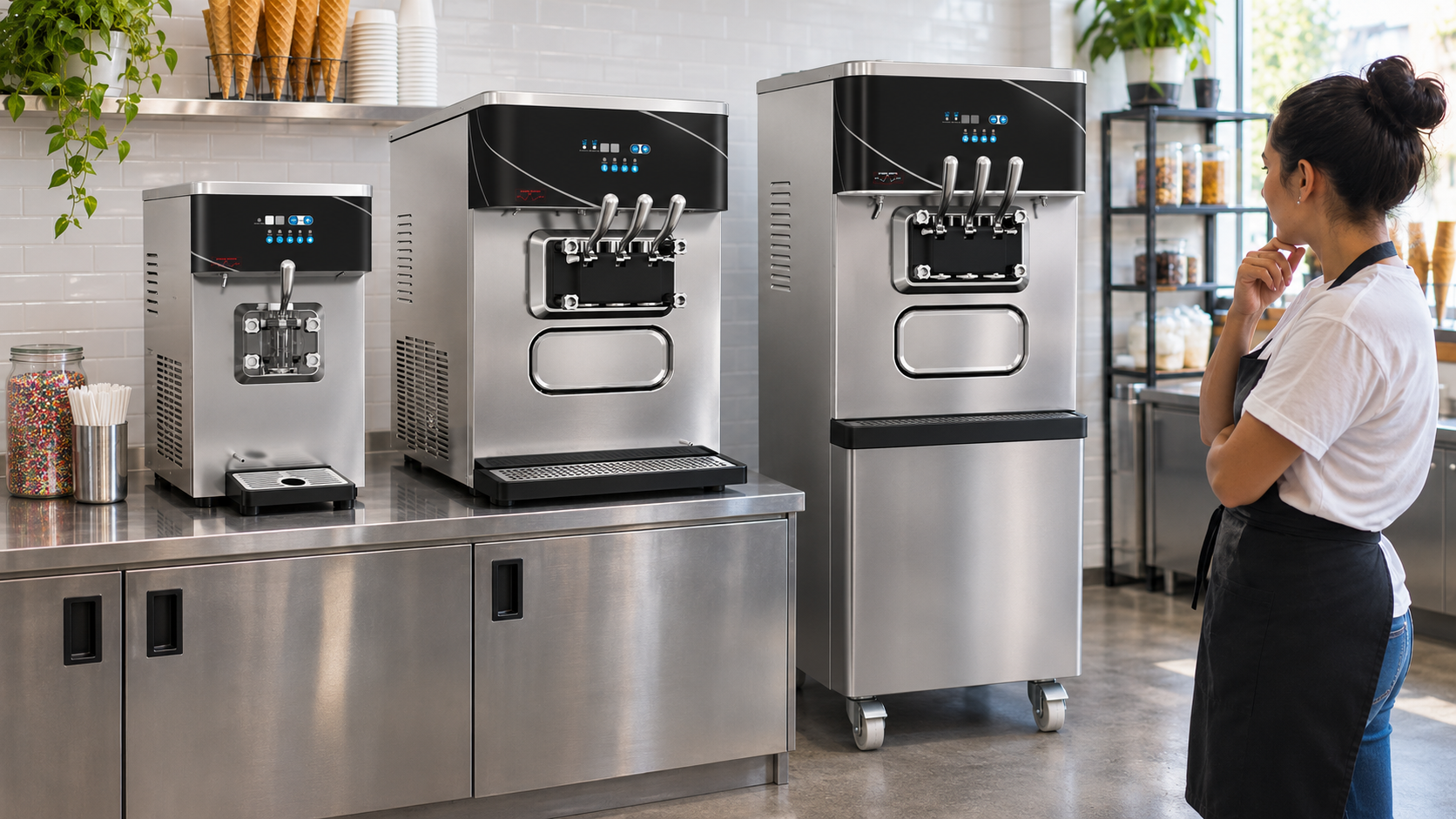
The format you choose affects both capacity and where you can place the machine. Countertop models suit smaller premises with limited space and moderate demand. Floor-standing models suit higher-volume operations that need greater output and more flavour options. A common approach is to choose the format that matches your peak demand first, then confirm that your premises can accommodate it. Operators who reverse this order often find a machine they love will not fit their counter. For high-volume sites, see the high-output floor-standing dual-flavour model. Consider a countertop unit if your peak is modest and your floor space is tight. Consider a floor-standing unit if you expect sustained queues, need to serve several flavours, or are planning growth. A compact gravity-fed countertop machine with adjustable hardness and automatic operation suits smaller premises.Soft Serve Machine Dimensions and Space Requirements
Measure your intended location before you shortlist machines. Record the available width, depth and height, and allow clearance for the door, the drip tray, cleaning access and the service engineer. Working in metric, note the following for each machine you consider:- Overall footprint in millimetres (width x depth)
- Overall height, including any canopy or topping station
- Clearance required at the back and sides for airflow
- Weight, especially if the machine will sit on a worktop or in a van
Electrical, Ventilation and Site-Readiness Checks
Before you commit to a model, confirm that your premises can run it safely. Check the electrical supply, the available circuit, and whether the machine needs a dedicated socket. Speak to a qualified electrician if you are unsure. Ventilation matters because refrigeration systems release heat. Ensure there is adequate airflow around the unit, and avoid placing it against a wall or in an enclosed cupboard unless the manufacturer’s guidance allows it. Also consider water supply and drainage if your chosen machine requires them, and the access route for delivery and future servicing. Site readiness problems discovered after delivery are among the most expensive to fix.Total Cost of Ownership by Machine Size
The purchase price is only one part of what a machine costs you over its working life. Running costs, maintenance, downtime and the cost of an undersized or oversized unit all add up. Pricing depends on the model, the format, the flavour configuration and the terms you agree. For current prices or a quotation tailored to your premises, visit the Longo & Co website or contact our team directly. Compare buying and renting options to see the full financial picture for your chosen size. When comparing options, consider:- Energy consumption at your expected duty cycle, not just at idle
- Expected maintenance intervals and the availability of technical support
- The cost of lost sales if a smaller machine cannot meet your peak
- The cost of idle capacity if a larger machine is bought for a demand that never arrives
- Whether a rental arrangement suits a seasonal or event-based requirement better than purchase
Booking Your Sizing Consultation with Longo & Co
Once you have estimated your peak demand, measured your site and shortlisted formats, the remaining question is which specific machine fits. This is where a sizing conversation saves time. A sizing conversation can review your figures, check them against the machine specifications, and point out where your assumptions may need adjusting. If you would like a second opinion before you buy, you can contact Longo & Co to discuss your requirements. Bring your peak-hour estimate, your floor plan and your electrical details, and we will help you match the machine to the business you are actually running.Frequently Asked Questions
How do I choose the right size soft serve machine for my business?
Start with your busiest hour rather than your average day. Estimate how many customers you serve in that hour, multiply by the share who will buy soft serve, and multiply again by your typical serving size. Compare that figure against the machine’s sustained output per hour, not its maximum advertised figure. Leave a margin of around 20 to 30 per cent so the machine does not run at its limit for long periods. Then check that the hopper, floor space and electrical supply suit the model you shortlist.
How much soft serve can a commercial machine produce per hour?
Output varies by model, freezing cylinder size and the product being served, so the manufacturer’s rated output per hour is the starting point. Treat that figure as a best case. Sustained output over a full service is usually lower because the cylinder must recover between draws. Ask for the rated output and the recovery time, and confirm both against your own peak-hour estimate before you buy. Longo & Co can talk through the specifications for individual models on a call.
What size soft serve machine do I need for a café?
Most independent cafés that add soft serve as a side offer need a compact, single-cylinder countertop model, provided their peak demand is modest and the product is served in small portions. Cafés expecting steady queues at weekends, or planning to offer two flavours at once, should look at larger cylinders or a twin-flavour model. Work out your peak-hour demand first, then choose the smallest machine that covers it with a sensible margin.
How do I estimate soft serve demand during peak periods?
Count customers during your busiest 30 to 60 minutes across several typical days, then apply the share who usually buy a dessert or treat. Multiply by your average serving size to get servings per hour. Add a buffer for unusual days such as sunny weather or events. The gap between your peak estimate and the machine’s sustained output shows whether you will face queues, and how long they are likely to last.
How much space does a commercial soft serve machine need?
Footprint varies widely. Countertop machines typically need a clear counter section wide enough for the unit, plus clearance at the back and sides for airflow and servicing. Floor-standing machines need a larger floor footprint and more room for access. Check the manufacturer’s installation drawing for exact dimensions, and allow for the hopper lid, drip tray and a comfortable working area for staff.
What is the difference between countertop and floor-standing soft serve machines?
Countertop machines suit cafés, small dessert outlets and sites with limited floor space, and they usually have lower output and simpler installation. Floor-standing machines have larger cylinders and higher output, which suits leisure venues and high-volume parlours. The right choice depends on peak demand, available space and whether the machine will be used for a single flavour or several.
Does a larger soft serve machine use more power?
Generally, yes. Larger cylinders and more powerful compressors draw more electricity, both when running and during recovery between draws. However, efficiency varies between models, so compare rated power consumption and ask about energy-efficient refrigeration features. Check that your electrical supply and circuit can take the machine’s requirement before installation, and factor running costs into your total cost of ownership.
How many flavours can a commercial soft serve machine serve?
Single-flavour machines serve one product, while twin or twist machines dispense two flavours, often side by side or swirled together. Some models allow flavour changes by switching mix, but this takes time for cleaning and recovery. Decide how many flavours you need at peak times, because serving multiple flavours from one cylinder can reduce the output available for each.